
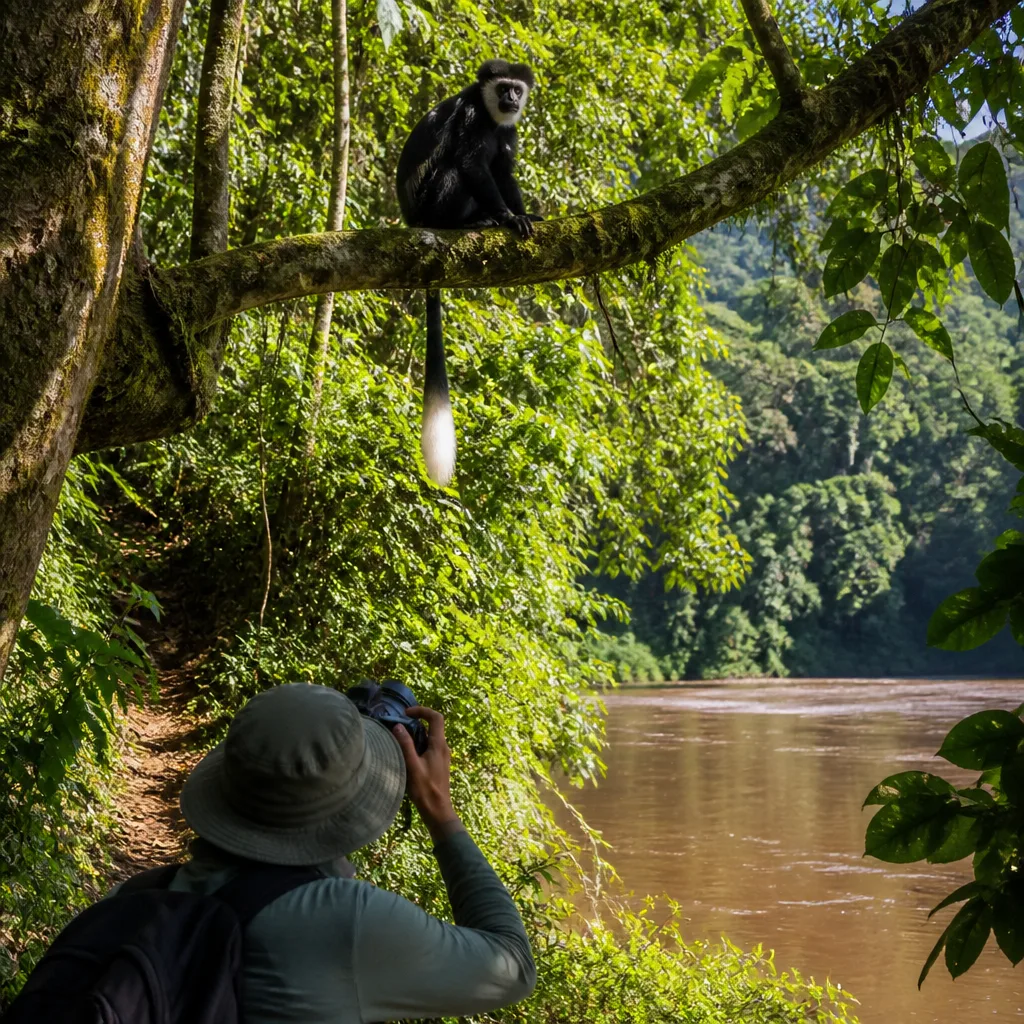
An international research team has confirmed that a small, canopy-dwelling black monkey from the Democratic Republic of Congo represents a species new to science. The primate has been designated Colobus congoensis and the researchers recommend the vernacular name Likweli, drawn from local community usage.
Decade of clues culminates in species recognition
Field evidence that led to the identification began more than a decade ago. A partial photograph taken in 2008 in what later became Lomami National Park showed an unfamiliar animal. Clearer documentation emerged in 2018 when Congolese field researcher Jean Pierre Kapale and his patrol photographed a black Colobus with pale facial markings and a distinctive white patch beneath its tail. Subsequent field work between 2018 and 2022 yielded further records.
“Our team evaluated multiple datasets that all reached the same conclusion: Likweli is a distinct species of Colobus monkey we haven’t seen before,”
The quote above was provided by Julia Arenson, a Yale postdoctoral fellow and co‑author of the study. Conservation biologist Terese Hart described the primate as both previously unrecorded and geographically restricted, noting the species is “extremely rare and with a limited range.”
Where and how often it was seen
From 2018 through 2022, field teams logged 114 detections across roughly 1,700 square kilometres. Most observations were clustered near the Lomami River in mature upland forest characterised by deep clay soils. The animal’s appearance includes a predominantly black coat with orange‑cream skin around the mouth and nose and a white patch under the tail.
- First partial photograph: 2008 (Lomami area)
- Clear photographic series: 2018 (Kapale patrol and others)
- Confirmed detections: 114 between 2018–2022
- Habitat: Mature upland forest near Lomami River, deep clay soils
| Metric | Value |
|---|---|
| Confirmed detections | 114 |
| Survey area | ~1,700 km² |
| Years of concentrated records | 2018–2022 |
Significance and next steps
Primate species discoveries in Africa are uncommon; the authors note this is only the fifth African monkey identified from a previously unknown population in the past 75 years. The finding has immediate implications for conservation planning, given the species’ apparent rarity and narrow distribution. Researchers documented the animal primarily via photographic detections and recommend further field surveys, population assessments and habitat protection measures to determine conservation status and inform management.
The identification underscores the value of sustained field patrols and the contributions of Congolese researchers and local communities in documenting biodiversity in remote forests.
This article is based on material released by the research team and associated field reports.